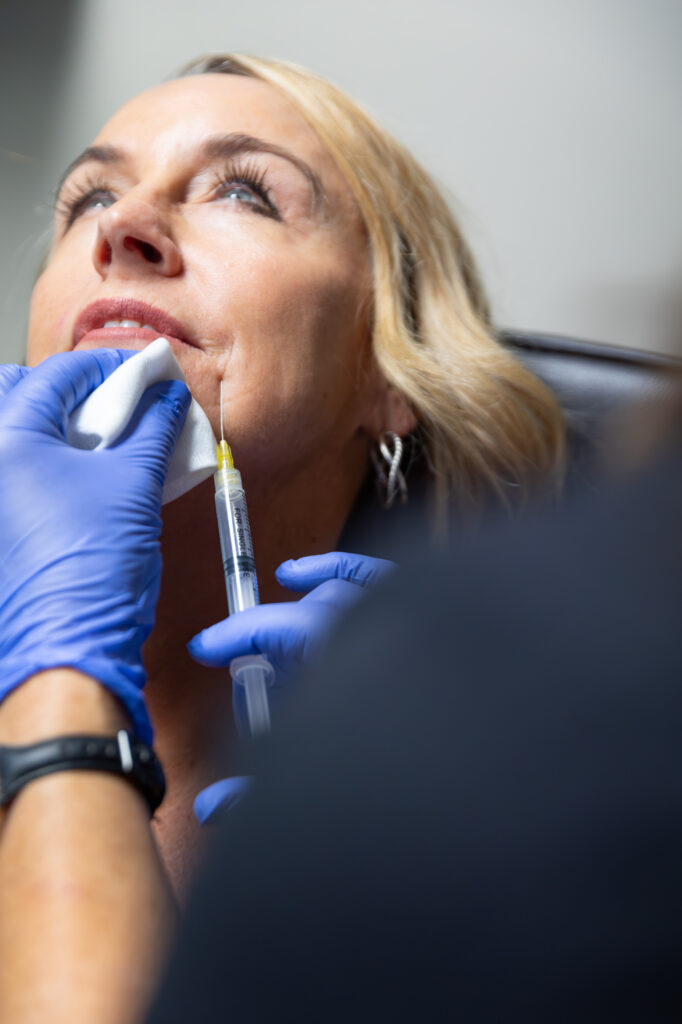
Facial aging tends to show up in the mirror as lines, yet much of it starts well beneath the surface. Over the years the cheeks flatten and the skin gradually loses the firm support that once held it in place. For many people, the first instinct is to replace that lost fullness with a syringe of hyaluronic acid filler, which delivers a visible change before they leave the chair. A growing share of patients at our Pinellas Park med spa are asking about a different option instead.
That option is Sculptra, a collagen-stimulating injectable that rebuilds volume slowly over a period of months. The debate over Sculptra vs traditional fillers comes down to how each product works inside the skin. Fillers add volume by occupying space, while Sculptra prompts the body to produce its own collagen. That single distinction shapes how quickly results appear and how long they last.
What Causes Facial Volume Loss?
Facial volume loss is the gradual thinning of the fat pads and collagen that give the face its shape. Collagen production begins to decline in the mid-twenties and continues to drop each year after that. At the same time, the fat compartments in the cheeks and temples shrink and shift downward, leaving less scaffolding for the skin to rest on.
Most people begin to notice the change in their late thirties or forties. The cheeks lose their curve, and the folds running from the nose to the corners of the mouth deepen as the tissue above them loses support. Sun exposure and significant weight loss can accelerate the process, which is why patients following a medical weight loss plan sometimes notice a hollower look in the face as the scale moves.
Identifying the cause matters because it shapes the treatment. When the underlying problem is a broad loss of collagen and fat spread across the midface, placing gel at a few isolated points may soften the symptoms while leaving the larger pattern of loss in place.
How Does Sculptra Work?
Sculptra is an injectable biostimulator made from poly-L-lactic acid (PLLA), a biocompatible synthetic material with a long history in medicine, including its use in dissolvable stitches. The U.S. Food and Drug Administration first approved Sculptra in 2004 to restore facial fat loss and later cleared it for nasolabial folds and other facial wrinkles. In 2023, the agency expanded that approval to include fine lines and wrinkles in the cheek region.
Once placed in the deeper layers of the skin, the PLLA microparticles signal fibroblasts, the cells responsible for producing collagen, to become more active. Over the following weeks and months, the body lays down new collagen fibers around the particles while the PLLA itself is slowly metabolized and absorbed. By the end of the process, the added volume consists of the patient’s own tissue.
This mechanism accounts for Sculptra’s most distinctive trait. Results build gradually, with many patients seeing a meaningful difference six to eight weeks after a session and continued refinement for several months after the final one. Readers interested in the biology can find more detail in our article on the science behind Sculptra.
How Do Traditional Fillers Work?
Traditional dermal fillers are gel-based injectables, most often made from hyaluronic acid (HA), a sugar molecule that occurs naturally in the skin and holds onto water. Well-known brands such as Juvéderm and Restylane belong to this category. When the gel is placed beneath a wrinkle or into the cheek, it physically occupies space and lifts the tissue above it, so the result is visible as soon as the appointment ends.
Depending on the product and the area treated, HA fillers generally last between six and eighteen months before the body breaks the gel down. They also offer a useful safety net. If a patient dislikes the outcome, an enzyme called hyaluronidase can dissolve HA filler within days, something that is not possible with Sculptra. Our post on dermal fillers: fact vs fiction clears up several common misunderstandings about how these gels behave over time.
| The core difference: Traditional fillers restore volume directly with a gel that is visible right away. Sculptra restores volume indirectly by prompting your body to build new collagen, so the change arrives gradually and tends to last considerably longer. |
Sculptra vs. Traditional Fillers: How Do They Compare?
The table below summarizes how the two approaches differ on the factors patients ask about most often during a consultation.
| Factor | Sculptra (PLLA) | Traditional HA fillers |
|---|---|---|
| Main ingredient | Poly-L-lactic acid microparticles | Cross-linked hyaluronic acid gel |
| How it works | Stimulates new collagen production | Fills space and attracts water |
| When results appear | Gradually, over roughly two to three months | Immediately after injection |
| How long results last | Up to two years or longer | About 6 to 18 months, depending on product and area |
| Typical sessions | Two to three, spaced several weeks apart | Usually one, with an optional touch-up |
| Best suited for | Broad volume loss across the cheeks and temples | Targeted areas such as the lips and individual folds |
| Reversible? | No; results soften gradually as collagen ages | Yes, with hyaluronidase |
| Aftercare | Daily massage following the 5-5-5 rule | Minimal; avoid pressing on the area briefly |
The comparison reveals a trade-off most patients weigh carefully. Traditional fillers offer speed and precision. Sculptra offers durability along with a softer, more gradual change that friends and colleagues rarely recognize as treatment.
Why Do Patients Choose Sculptra for Facial Volume Loss?
Patients who choose Sculptra usually do so for reasons tied to how they want their face to look over the long term. Four motivations come up again and again in our treatment rooms.
The Change Looks Natural
When volume returns over several months, the people around a patient rarely notice a single moment of change. They tend to say the person looks rested or healthy, without being able to point to a procedure. For patients who value discretion, this quality alone often settles the decision. Because the result is the patient’s own collagen, it also moves naturally with every smile and change of expression.
The Results Last Longer
Longevity is the reason cited most often. In the randomized trial that supported Sculptra’s approval for nasolabial folds, investigators rated overall improvement above 85 percent in PLLA-treated patients through 25 months after the final session, while the comparison group treated with a collagen-based filler lost most of its correction within the first year (source). A patient who might otherwise book filler once or twice a year can often go much longer between Sculptra maintenance sessions.
It Addresses Broad Areas of Loss
Sculptra is injected across a wider area than a typical filler, which makes it well suited to volume loss spread throughout the midface and temples. The treatment restores support across a whole region, so the face regains its contour evenly. This is also why many patients who have lost a substantial amount of weight find Sculptra a good fit for the hollowing that can follow.
Skin Quality Improves Along With Volume
New collagen forms within the dermis itself, so many patients notice firmer skin with a smoother texture in the treated areas. The FDA’s 2023 approval for cheek wrinkles reflects this effect on fine lines and crepey skin, a concern that HA fillers are generally less suited to correct.
When Is a Traditional Filler the Better Choice?
Sculptra is a strong option for many adults, though some goals call for a different tool. Hyaluronic acid remains the standard for lip enhancement, because Sculptra is avoided in the lips due to the higher risk of small bumps forming in such a mobile area. HA also gives more precise definition along the chin and jawline, where a crisp, immediate outcome is usually the goal.
Timing can tip the decision too. HA is the practical choice when a result is needed by a fixed date, such as a wedding, and some first-time injectable patients prefer it for the reassurance of reversibility. Our team offers both treatments, and a provider specializing in dermal fillers in Clearwater can explain which product suits a given feature and timeline.
Who Is a Good Candidate for Sculptra?
Sculptra works best for healthy adults who have realistic expectations and are comfortable waiting for results to develop. Patients who tend to see the best outcomes include:
- Adults with gradual, widespread volume loss in the cheeks or temples who want improvement that builds steadily over time.
- Patients who have lost weight and noticed hollowing or looser skin in the face as a result.
- People who have relied on HA fillers for years and would like longer intervals between appointments.
- Anyone who prefers a subtle change that others read as looking refreshed.
Sculptra is not recommended for people with a history of keloid scarring or a known sensitivity to any of its components, and treatment is typically postponed during pregnancy or while an active skin infection is present in the area. Your provider will review your medical history in detail before recommending a plan.
What Does a Sculptra Treatment Plan Look Like?
Sculptra is delivered as a series of sessions. Most patients need two to three appointments spaced several weeks apart, with the exact number determined by the degree of volume loss and the size of the treatment area. The product is mixed with sterile water, often with lidocaine added for comfort, and placed with a fine needle or a blunt cannula. Each visit usually takes less than an hour, including time for topical numbing.
Aftercare plays a real role in the outcome. Two instructions matter most in the first days:
- Massage the treated areas using the 5-5-5 rule, which means five minutes of massage five times a day for five days, to help the product distribute evenly.
- Skip strenuous exercise for 24 hours, and wear broad-spectrum sunscreen every day for the following four weeks.
Mild swelling or bruising at the injection points is common and usually settles within a few days. Most people return to work the same day or the next.
| Set expectations early: The fullness you see right after a Sculptra session comes mostly from the water used to mix the product, and it fades within a few days. The true result develops gradually, so plan to judge your outcome about three months after your final session. |
Can Sculptra and Traditional Fillers Be Used Together?
Yes, and many experienced injectors prefer to combine them. A common approach uses Sculptra to rebuild the foundation across the midface and temples, then adds a small amount of HA filler to refine a specific feature such as the lips or a single deep fold. This layered strategy mirrors the way the face ages, with structural loss underneath and more localized change on the surface.
Neuromodulators address a separate concern. Lines created by muscle movement, such as frown lines and crow’s feet, respond best to Botox in Clearwater, which can be scheduled around a Sculptra series without conflict. For patients bothered by texture and mild laxity, RF microneedling in Clearwater offers another way to encourage collagen production. The order and spacing of these treatments is best decided during a consultation.
Is Sculptra Worth the Investment Compared With Fillers?
Sculptra is priced per vial, and a full plan generally involves several vials across multiple sessions, so the upfront cost is often higher than a single syringe of HA filler. The picture shifts when that cost is measured against how long the result holds. Because Sculptra results commonly last up to two years or longer, the cost per year of correction can be comparable to, or lower than, repeated filler appointments over the same period. Patients weighing the numbers can ask about financing and membership options during their visit.
Choosing Between Sculptra and Traditional Fillers in Pinellas Park
At Success by Design, every injectable plan starts with a careful assessment. Our team uses Vectra 3D imaging to map the face and show exactly where volume has changed, which helps patients see whether their concern is best served by collagen stimulation or by targeted filler. Patients from Clearwater and across the Tampa Bay area visit our Pinellas Park office for injectables planned around long-term goals rather than quick fixes.
If you have noticed hollowing in your cheeks or temples and want a result that simply looks like a well-rested version of yourself, Sculptra in Clearwater may be the right place to start. You can book a free consultation to compare your options with one of our providers and build a plan that fits both your face and your schedule.
References
- Investigator Global Evaluations of Efficacy of Injectable Poly-L-Lactic Acid Versus Human Collagen in the Correction of Nasolabial Fold Wrinkles. Aesthetic Surgery Journal, 2011. pubmed.ncbi.nlm.nih.gov
- Sculptra (P030050/S039) Approval for Cheek Wrinkles. U.S. Food and Drug Administration. fda.gov
- Dermal Fillers (Soft Tissue Fillers). U.S. Food and Drug Administration. fda.gov