Microneedling has been part of aesthetic medicine for decades, and its central idea has aged well. Tiny, controlled punctures prompt the skin to repair itself, and that repair process lays down fresh collagen. The equipment is what has changed. Radiofrequency (RF) microneedling added heat to the process, and newer platforms such as Exion now use artificial intelligence to regulate how that heat is delivered with every pulse.
At our Pinellas Park med spa, Exion RF microneedling is one of the treatments patients ask about most for acne scarring and the soft, crepey texture that tends to appear along the jaw and neck. Many of those patients also want to know why we finish each session with exosomes. The answer has a lot to do with timing. The minutes after microneedling are when the skin is most receptive to whatever is placed on it, and exosomes are among the most closely studied regenerative ingredients for that window. This article explains how each part of the treatment works and what the research shows so far.
What is Exion RF microneedling?
Exion RF microneedling, which the manufacturer markets as Exion Fractional RF, is a skin rejuvenation treatment that combines microneedling with monopolar radiofrequency energy. It is one of four applicators on the Exion platform, a system developed by BTL Aesthetics, the company behind Emface and Emsculpt NEO.
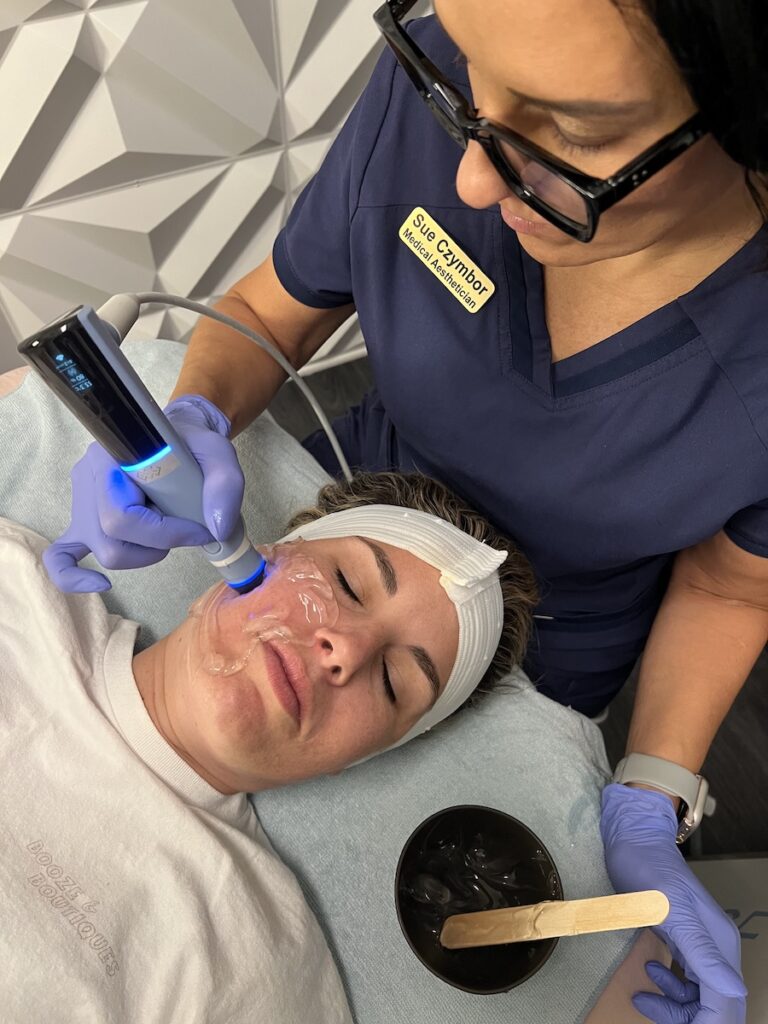
During treatment, a grid of fine needles enters the skin to a set depth while RF energy travels into the dermis, the layer where cells called fibroblasts produce collagen and elastin. The needles create microscopic channels that set off the body’s wound-healing response. At the same time, the RF energy heats the surrounding tissue to a controlled temperature. That heat causes existing collagen fibers to contract and signals the skin to build new ones over the following months.
Exion’s defining feature is its AI pulse control. The handpiece continuously reads the electrical resistance of the tissue the needles are sitting in, a property known as impedance, and adjusts the energy output to match. Because each pulse is calibrated in real time, providers can usually treat an area in a single pass. Many earlier RF microneedling devices needed two or more passes over the same skin to reach a comparable effect, which added time and discomfort. Readers who want a closer look at the technology itself can find more in our earlier article on Exion as a new and improved RF microneedling technology.
How does Exion compare with traditional microneedling?
Traditional microneedling relies entirely on mechanical injury. A pen or roller punctures the skin, and the healing response handles the rest. Improvement per session tends to be modest, which is why standard microneedling series often run longer before patients see the change they are hoping for.
RF microneedling builds on that mechanism by adding thermal energy at depth. The heat produces a firming effect that needling alone generally cannot match, so RF devices are the stronger choice when a patient’s concerns include mild laxity along with texture. Exion carries that progression a step further. Its monopolar design allows RF energy to spread beyond the needle tips into deeper tissue, so the treatment can reach the reticular dermis without the needles themselves going as deep. Patients tend to find this noticeably more comfortable, and most of the people we treat complete their sessions without topical numbing. Our page on RF microneedling in Clearwater outlines the full range of concerns the treatment addresses.
What are exosomes?
Exosomes are extracellular vesicles, tiny membrane-bound sacs that cells release to communicate with one another. Most measure roughly 30 to 150 nanometers across, small enough that hundreds of them could line up across the width of a single human hair. Each one carries proteins along with fragments of genetic material such as microRNA. When an exosome reaches a neighboring cell, that cargo can influence how the receiving cell behaves, including how actively it repairs tissue and how it responds to inflammation.
The exosomes used in regenerative aesthetics are typically isolated in a laboratory from cultured donor cells, most often stem cells derived from adipose (fat) tissue, and then purified into a serum or gel. The finished product contains no living cells. That distinction is a large part of why researchers have taken an interest in exosomes as a cell-free way to capture some of the signaling activity associated with stem cells.
Patients should also know where this ingredient stands with regulators. The U.S. Food and Drug Administration has stated that no exosome product is currently approved to treat a disease or medical condition, and the agency has cautioned consumers about clinics that inject exosomes while making unproven medical claims. In aesthetic practice, exosome solutions are applied topically as part of post-treatment skin care. They work best as a supporting step within a larger protocol, and that is exactly how we use them.
Why do we pair Exion RF microneedling with exosomes?
Our reasoning rests on two practical considerations. The first is access, and the second is recovery.
Microneedling opens a short delivery window
Healthy skin is a remarkably effective barrier. Its outermost layer, the stratum corneum, keeps most large molecules from passing through, which limits what any topical product can accomplish on its own. Microneedling changes that for a brief period. In the hours after treatment, the microscopic channels created by the needles allow topical ingredients to reach layers they would otherwise never touch. Applying exosomes during that window places them where the skin’s repair activity is already underway.
Exosomes support the recovery phase
RF microneedling works by creating a controlled injury, and the skin’s response to that injury includes temporary redness and swelling. Exosomes are thought to help regulate this inflammatory phase and encourage more organized tissue repair. The clinical evidence is still developing, although early results are encouraging. In a double-blind, randomized split-face trial of 25 patients with acne scars, the side of the face treated with an adipose stem cell-derived exosome gel after fractional laser resurfacing improved by 32.5 percent on a standard scar-grading scale, compared with 19.9 percent on the side treated with a control gel (source). The exosome-treated side also showed milder redness and a shorter recovery period.
That trial used a fractional CO2 laser, so its findings apply to RF microneedling by analogy. Both treatments create controlled microscopic injuries that the skin must repair, however, and the logic behind the pairing holds in both cases. The goal is to give the skin useful support at the moment it is rebuilding.
| Why the timing matters: We apply exosomes immediately after the Exion pass, while the microchannels are still open. The same solution applied to intact skin a few days later would have far less access to the deeper layers where collagen remodeling takes place. |
How does Exion with exosomes compare with Exion alone?
Both options use the same device and the same treatment settings. The difference lies in what happens in the minutes after the needles lift away. The table below summarizes how the two approaches compare on the points patients raise most often during a consultation.
| Factor | Exion RF microneedling alone | Exion RF microneedling with exosomes |
|---|---|---|
| Core mechanism | Microchannels and RF heat stimulate new collagen and elastin | Same mechanism, with exosomes applied over the open microchannels |
| Post-treatment topical | Soothing hydrating serum | Exosome solution, followed by soothing aftercare |
| Typical redness | Usually fades within a day or two | Often milder, with many patients reporting a quicker return to normal |
| Appointment time | About 30 to 60 minutes, depending on the area | Adds only a few minutes |
| Strength of evidence | Well established across many published studies | Promising but early, with smaller trials to date |
| Best suited for | Patients focused on texture and mild laxity | Patients with acne scarring or limited room for visible downtime |
For most patients, the choice depends on goals and schedule. Those treating significant scarring, or those who cannot easily take time away from work and social plans, tend to see the greatest value in adding exosomes.
What concerns can the combination improve?
Exion RF microneedling with exosomes is used primarily on the face and neck, although the Exion Fractional RF applicator can treat areas of the body as well. The concerns that respond best include:
- Atrophic acne scars, including the rolling and boxcar scars that sit below the surface of the skin.
- Fine lines and crepey texture, particularly along the lower face and neck.
- Enlarged pores and rough, uneven texture left behind by sun exposure or past breakouts.
- Mild skin laxity in patients who want firmer skin without surgery or extended downtime.
The same principle extends beyond the face. Our team also combines RF microneedling with exosomes on the scalp, where the treatment is used to support thinning hair. Patients interested in that application can read more about RF microneedling and exosomes for hair restoration in Clearwater.
Who is a good candidate for Exion RF microneedling with exosomes?
Good candidates are healthy adults with acne scarring or early laxity who want gradual, natural-looking improvement and are comfortable with a treatment series. Because Exion relies on RF energy instead of light, it is generally considered appropriate for a wide range of skin tones, including darker skin types that carry a higher risk of pigment changes with certain laser treatments.
Some situations call for postponing treatment or choosing a different option. Patients who have taken isotretinoin (Accutane) within the past three months usually need to wait, as do patients with an active skin infection or a cold sore outbreak in the treatment area. Exion is also avoided during pregnancy and while breastfeeding. Anyone with a pacemaker or another implanted electronic device should mention it during the consultation, since RF energy may not be appropriate. A history of keloid scarring or slow wound healing also deserves a careful conversation before treatment begins.
What happens during an Exion and exosome appointment?
Every Exion RF microneedling session at Success by Design begins with skin preparation. We pair each treatment with a HydraFacial in Clearwater and dermablading, which clear away debris and dead surface cells so the skin is clean and receptive before any energy is applied.
Topical numbing is available on request, though most patients find Exion comfortable enough to go without it. The provider then moves the handpiece across the treatment area in a single pass while the AI system adjusts energy delivery in real time. Patients typically describe the sensation as warmth with light pressure. A full-face session usually takes between 30 and 60 minutes, depending on the size of the area.
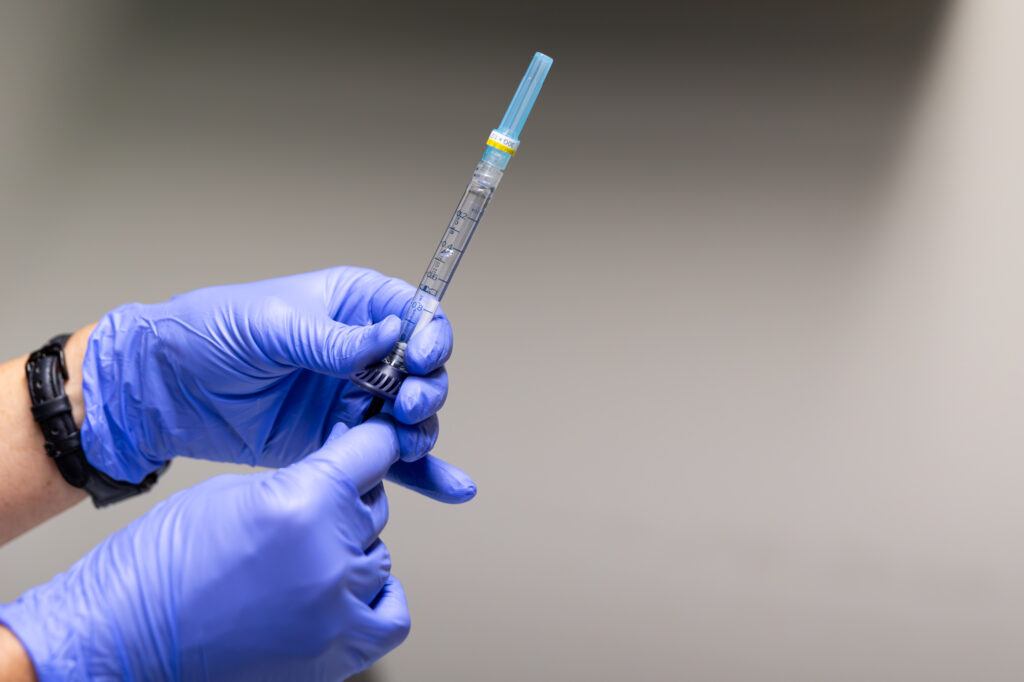
Immediately afterward, the exosome solution is applied across the treated skin and gently worked in while the microchannels remain open. Patients leave with written aftercare instructions and can usually return to most daily activities the same day.
| What to expect in the mirror: Treated skin usually looks pink or flushed for a day or two, similar to a mild sunburn. The collagen-building phase continues quietly for months after that, so the most meaningful changes appear well after the redness has faded. |
What is recovery like after treatment?
Downtime after Exion RF microneedling is minimal. Redness and mild swelling are the most common after-effects, and both usually settle within a day or two. Some patients notice slight dryness or flaking toward the end of the first week as the surface renews.
Aftercare protects both the result and the investment. Two instructions matter most during the first week:
- Keep the treated skin out of direct sun for at least a week, and wear a broad-spectrum sunscreen every day once the skin has calmed.
- Avoid heat and heavy sweating for about a week, which means skipping saunas and hard workouts, and wait a month before scheduling waxing or a chemical peel.
Gentle home care helps the skin finish its recovery. A regimen of medical-grade skincare chosen with your provider keeps the skin hydrated and protected while new collagen forms, and it helps preserve results between appointments.
How many sessions will you need, and when will you see results?
Most patients benefit from a series of three to six sessions spaced two to three weeks apart. The exact number depends on the concern being treated. Deep acne scarring generally needs more sessions than mild texture changes, and your provider will recommend a plan after assessing your skin.
Some patients notice brighter, smoother skin within a week or two of the first session, partly because the surface has been freshly renewed. The structural changes take longer. Collagen remodeling builds gradually over the months following a series, which is why the most meaningful improvement in scarring and firmness usually becomes visible several months after the final appointment.
Results commonly last six to twelve months, and longer with periodic maintenance sessions. Collagen production continues to decline with age, so an occasional touch-up helps protect what the series has built.
Can Exion with exosomes be combined with other treatments?
Yes. Exion RF microneedling works on surface quality and dermal collagen, so it pairs well with treatments that act on different layers. Patients with volume loss in the cheeks or temples often add Sculptra in Clearwater, which stimulates collagen at a deeper level and restores contour gradually. For patients who want firmer skin without needles, the Exion platform also offers a face applicator that pairs RF with targeted ultrasound. Our page on Exion skin tightening in Clearwater explains how that applicator differs from the microneedling handpiece. The order and spacing of combined treatments is best planned during a consultation, since some procedures need time between them.
Exion RF microneedling with exosomes in Pinellas Park
At Success by Design, every skin plan starts with a thorough assessment. Our team uses Vectra 3D imaging to map scarring and texture across the face, which gives patients a clear baseline and makes progress easier to measure from one session to the next. Patients from Clearwater and across the Tampa Bay area visit our Pinellas Park office for treatment plans built around their skin and their schedule.
If acne scars or changes in skin texture have started to bother you, Exion RF microneedling with exosomes may be the right place to begin. You can book a free consultation to find out whether the treatment suits your skin and to map out a series with one of our providers.
References
- Combination Treatment with Human Adipose Tissue Stem Cell-derived Exosomes and Fractional CO2 Laser for Acne Scars: A 12-week Prospective, Double-blind, Randomized, Split-face Study. Acta Dermato-Venereologica, 2020. pmc.ncbi.nlm.nih.gov
- Radiofrequency Microneedling: A Comprehensive and Critical Review. Dermatologic Surgery, 2021. pubmed.ncbi.nlm.nih.gov
- Consumer Alert on Regenerative Medicine Products Including Stem Cells and Exosomes. U.S. Food and Drug Administration. fda.gov